
Why Is My Dog Scratching So Much?
There are four fundamentally different causes of excessive scratching in dogs — and the treatment for one can actively worsen another. Getting this right matters: allergy management for a dog who actually has fleas is wasted effort, and treating a dog for fleas when the problem is a food allergy delays months of unnecessary discomfort.
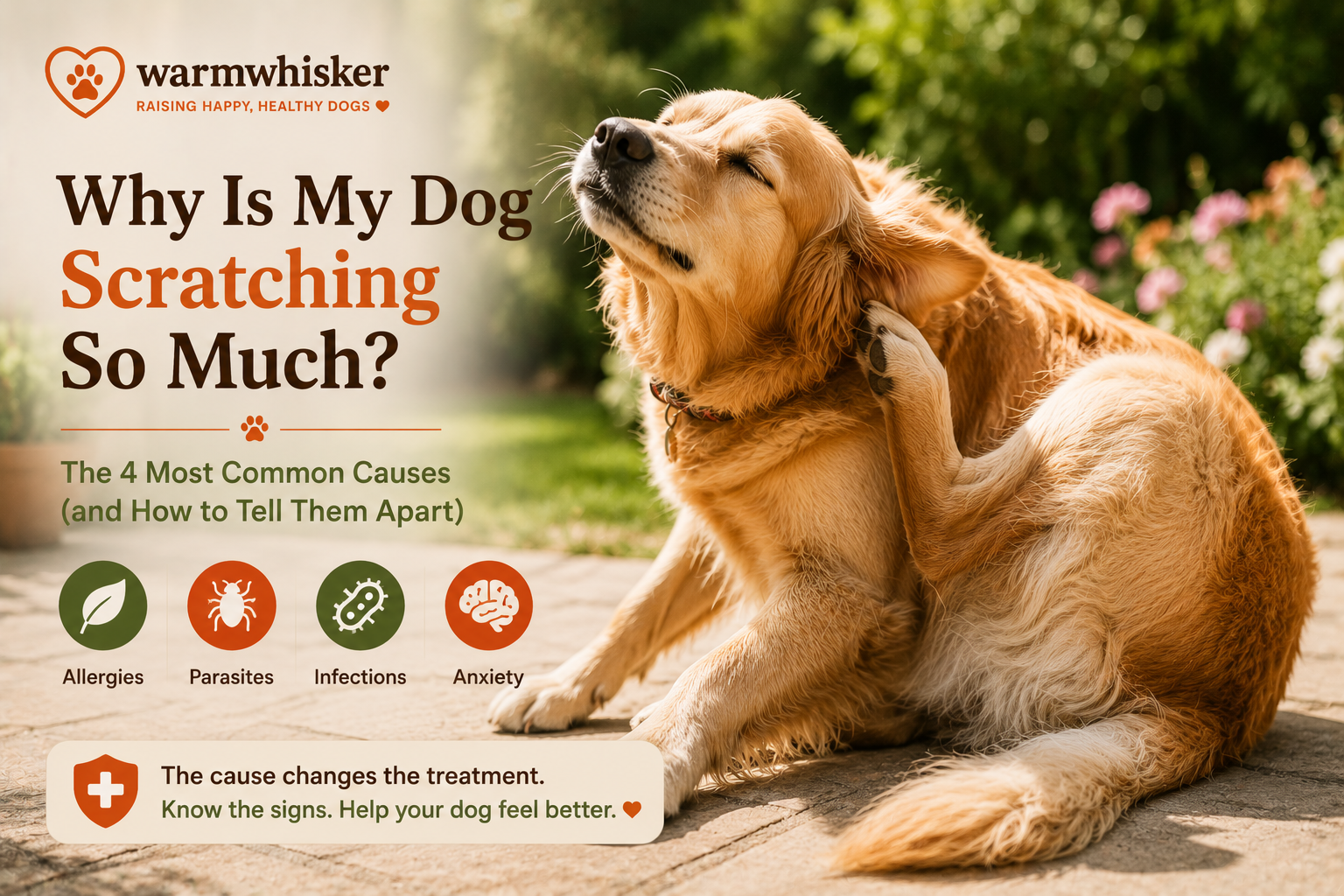
The four main causes of excessive scratching are: environmental allergies (atopy), food allergies, parasites (fleas, mites), and skin infections (bacterial or yeast). Each has a characteristic distribution pattern on the body and specific accompanying signs. The distribution of scratching is the first diagnostic clue.
Cause 1: Environmental allergies (atopy)
Canine atopic dermatitis (atopy) is the most common cause of chronic itching in dogs. Like hay fever in humans, it’s an allergic reaction to environmental allergens — pollen, house dust mites, mould spores, grass, storage mites. The immune system misidentifies these harmless particles as threats and mounts an inflammatory response that manifests in the skin.
Classic atopy signs
- Itching begins between 1 and 3 years of age (rarely before 6 months or after 3 years)
- Characteristic distribution: face and muzzle, ears, paws, belly, armpits, and groin — the areas that contact environmental surfaces
- Seasonal pattern in some dogs — worse in spring/autumn (pollen seasons)
- Saliva staining — red-brown discolouration of paw fur from chronic licking (as discussed in paw licking after walks)
- Recurrent ear infections — a common secondary complication of atopy
Atopy cannot be cured, but it can be managed very effectively. Treatments include immunotherapy (allergy shots or oral drops), newer medications like Cytopoint and Apoquel, and environmental management to reduce allergen exposure.
Cause 2: Food allergies and intolerances
Food allergies in dogs produce skin symptoms rather than the GI symptoms we might expect — this surprises many owners. A dog allergic to an ingredient in their food develops itchy skin, not necessarily vomiting or diarrhoea (though GI symptoms can co-occur).
Classic food allergy signs
- Year-round itching with no seasonal variation (distinguishes it from pollen-related atopy)
- Distribution often includes the ears, face, and perianal area (around the bottom)
- Recurrent ear infections
- Onset can occur at any age, even in a dog who has been eating the same food for years
The elimination diet — the only reliable diagnostic test
Commercial allergy panels (blood or skin prick tests) have poor reliability for food allergies in dogs. The only diagnostic tool that actually works is an elimination diet: feeding a novel protein and carbohydrate combination (a protein the dog has never eaten before) for 8–12 weeks, strictly. This is called a hydrolysed or novel protein elimination diet and must be done under veterinary supervision.
The most common food allergens in dogs: beef, chicken, dairy, wheat, and eggs. Dogs can develop allergies to foods they’ve eaten safely for years.
Cause 3: Parasites — fleas and mites
Fleas
Flea allergy dermatitis (FAD) is the most common parasitic cause of itching in dogs. A dog with FAD doesn’t react to the flea bite itself — they react to proteins in the flea’s saliva. A single flea bite can trigger intense itching that lasts days. Critically: you don’t need to see fleas to diagnose flea allergy. A dog who groomed off all their fleas still had the exposure.
Classic FAD distribution: base of the tail, lower back, and hindquarters. If your dog scratches in this area most intensely, check for flea dirt — tiny black specks that dissolve to a red-brown when wet (dried blood).
Sarcoptic mange (scabies)
Sarcoptes mites cause intense, severe itching that can affect any part of the body. It is highly contagious to other animals and to humans (it causes temporary itching in people). The itch from sarcoptic mange is characteristically much worse than typical allergy itching — often described as unbearable. It can sometimes be difficult to diagnose because the mites are hard to find on skin scrapes.
Demodex mites
Demodex mites live normally in dog hair follicles. In dogs with immune suppression or puppies with immature immune systems, they can overpopulate, causing hair loss and skin irritation. Unlike sarcoptic mange, it is not typically intensely itchy and is not contagious.
Cause 4: Bacterial and yeast skin infections
Secondary skin infections frequently complicate whatever the primary cause of scratching is — the damaged, inflamed skin provides a perfect environment for bacteria (Staphylococcus) and yeast (Malassezia). But infections can also be a primary cause of itching in dogs with skin barrier defects.
Bacterial (pyoderma) signs
- Pustules — small pus-filled spots, often visible on the belly where fur is sparse
- Crusting and scaling
- A musty or unpleasant skin smell
Yeast infection signs
- Greasy, waxy skin and coat
- Characteristic “corn chip” or musty smell, particularly from the ears or paws
- Brown discolouration in ear canals
- Particularly common in skin folds in brachycephalic breeds
Reading the distribution — your first diagnostic clue
| Location of scratching | Most likely cause |
|---|---|
| Face, paws, belly, armpits | Atopy (environmental allergy) |
| Base of tail, lower back, hindquarters | Flea allergy dermatitis |
| Ears, face, perianal area | Food allergy (often) |
| All over, intense and generalised | Sarcoptic mange or severe atopy |
| Paws specifically, post-walk | Contact allergens (see paw licking article) |
| Ears predominantly | Ear infection (often secondary to allergy) |
What to try at home
- Update parasite prevention — ensure flea, tick, and mite treatment is current and appropriate for your dog’s weight. Many over-the-counter products are ineffective.
- Check all animals in the household — flea treatment of one pet while others have untreated fleas resets the infestation
- Antihistamines — chlorphenamine (Piriton) can reduce allergic itching in some dogs; check with your vet for appropriate dosing
- Omega-3 fatty acids — fish oil supplementation supports the skin barrier and has modest anti-inflammatory effects; discuss with your vet
- Shampoo therapy — a gentle medicated or moisturising shampoo helps some atopic dogs; avoid frequent bathing with harsh shampoos
When to see a vet
- The scratching is severe enough to cause broken skin, bleeding, or hair loss
- Home management has not produced improvement after 2 weeks
- You suspect sarcoptic mange (intense all-body itching, contact with unknown dogs)
- The dog is keeping you or themselves awake with scratching
- The skin has a strong smell, visible pustules, or significant crusting
- The scratching began in a young adult dog with no previous skin history — early atopy management significantly improves long-term outcomes